
6 Things to Look for Before Buying a Portable Oxygen Concentrator in 2026

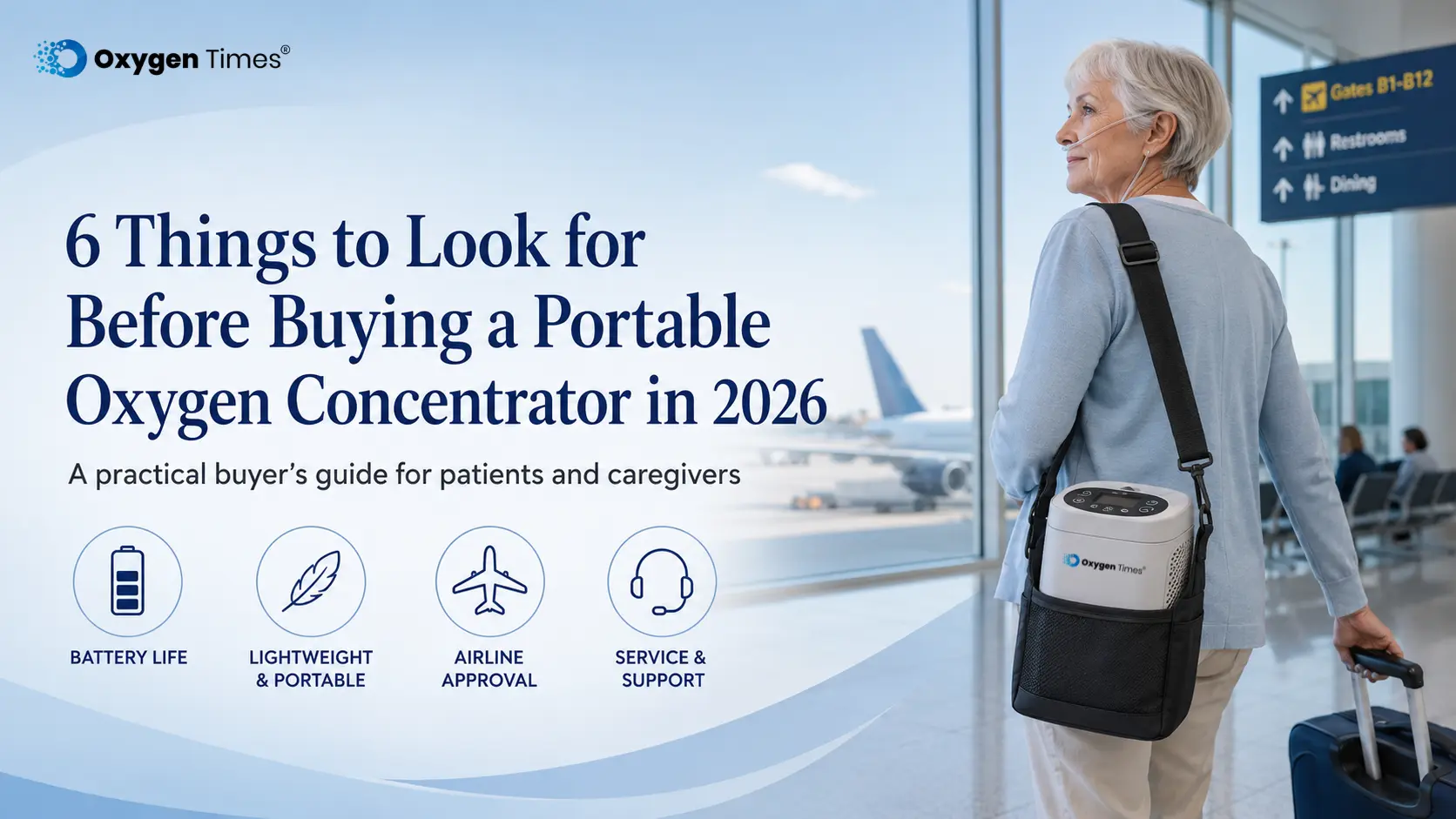
Buying a portable oxygen concentrator is not the same as buying a regular electronic device. A POC directly affects mobility, travel comfort, oxygen therapy routine, and long-term ownership cost.
Many buyers compare only the machine price, weight, and advertised battery backup. But in real use, the more important questions are different:
Is the battery affordable?
How much backup will it give at the user’s prescribed setting?
Is the machine light enough for a respiratory patient?
Are sieve beds user-replaceable?
Is service available in India?
Is the battery accepted by airlines?
Here are the 6 most important things to check before buying a portable oxygen concentrator in 2026.
1. Battery Price, Real Backup, and Charging Time Matter More Than “Up To” Claims
Battery is one of the most important things to check before buying a portable oxygen concentrator. Unfortunately, it is also one of the most ignored factors.
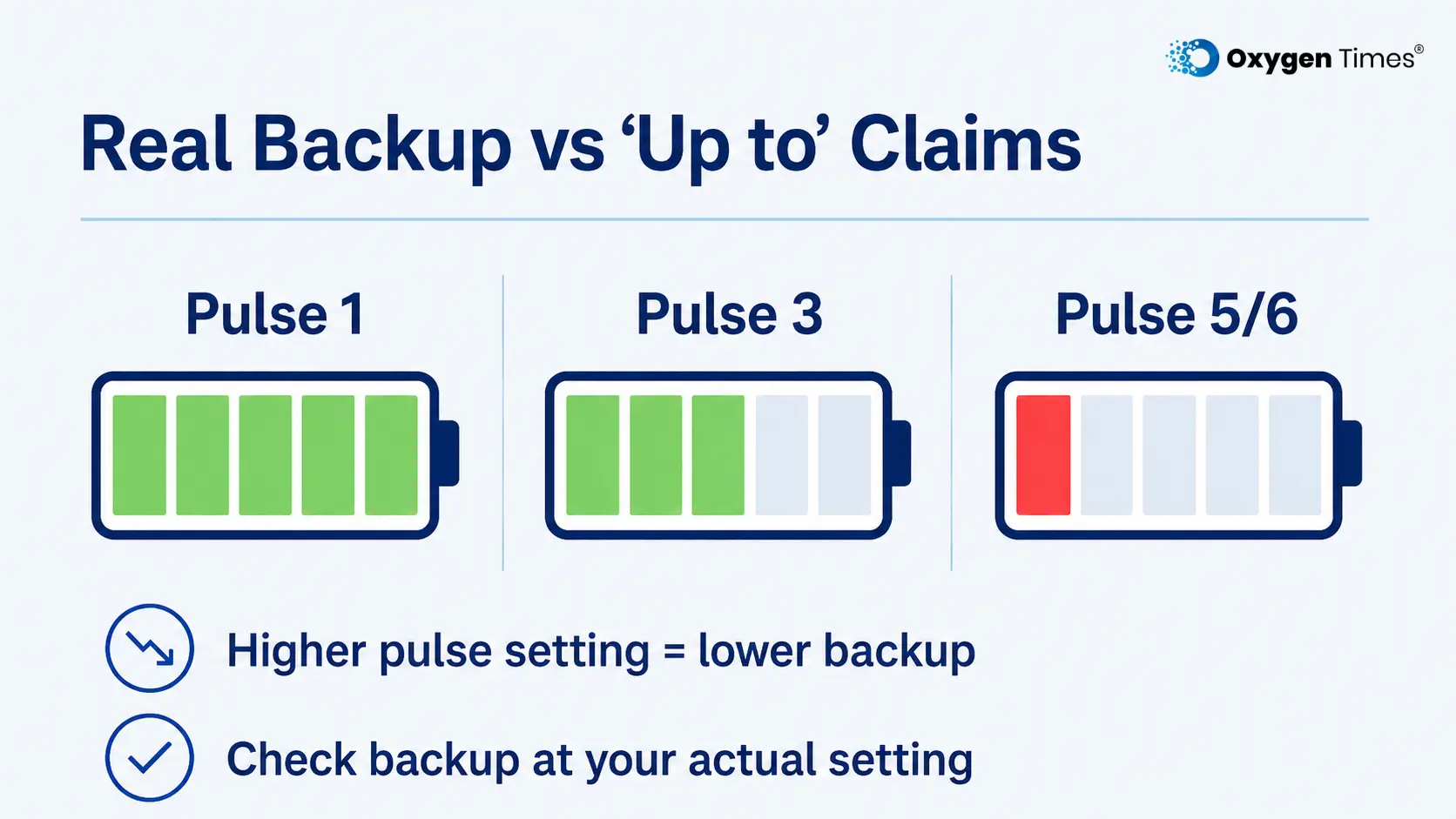
Most brands mention battery backup as an “up to” value. For example, a machine may say “up to 10 hours” or “up to 12 hours”. But this backup is usually calculated at the lowest pulse setting, often setting 1.
As the pulse setting increases, battery backup decreases.
So if a patient uses the machine at setting 3, 4, 5, or 6, the actual backup can be much lower than the maximum backup mentioned in the brochure.
Do not fall for only “up to” battery backup
Before buying, always ask:
- What is the battery backup at the user’s prescribed setting?
- Is the backup mentioned for single battery or double battery?
- How many batteries will be needed for outdoor use?
- How much does one replacement battery cost?
- How long does one battery take to charge?
A portable oxygen concentrator with long backup at setting 1 may not be the best choice if the user needs a higher pulse setting.
Battery replacement cost matters
Battery cost can make a big difference in long-term ownership.
In many premium American portable oxygen concentrators, replacement batteries can cost around ₹50,000 to ₹70,000, depending on the model and battery type.
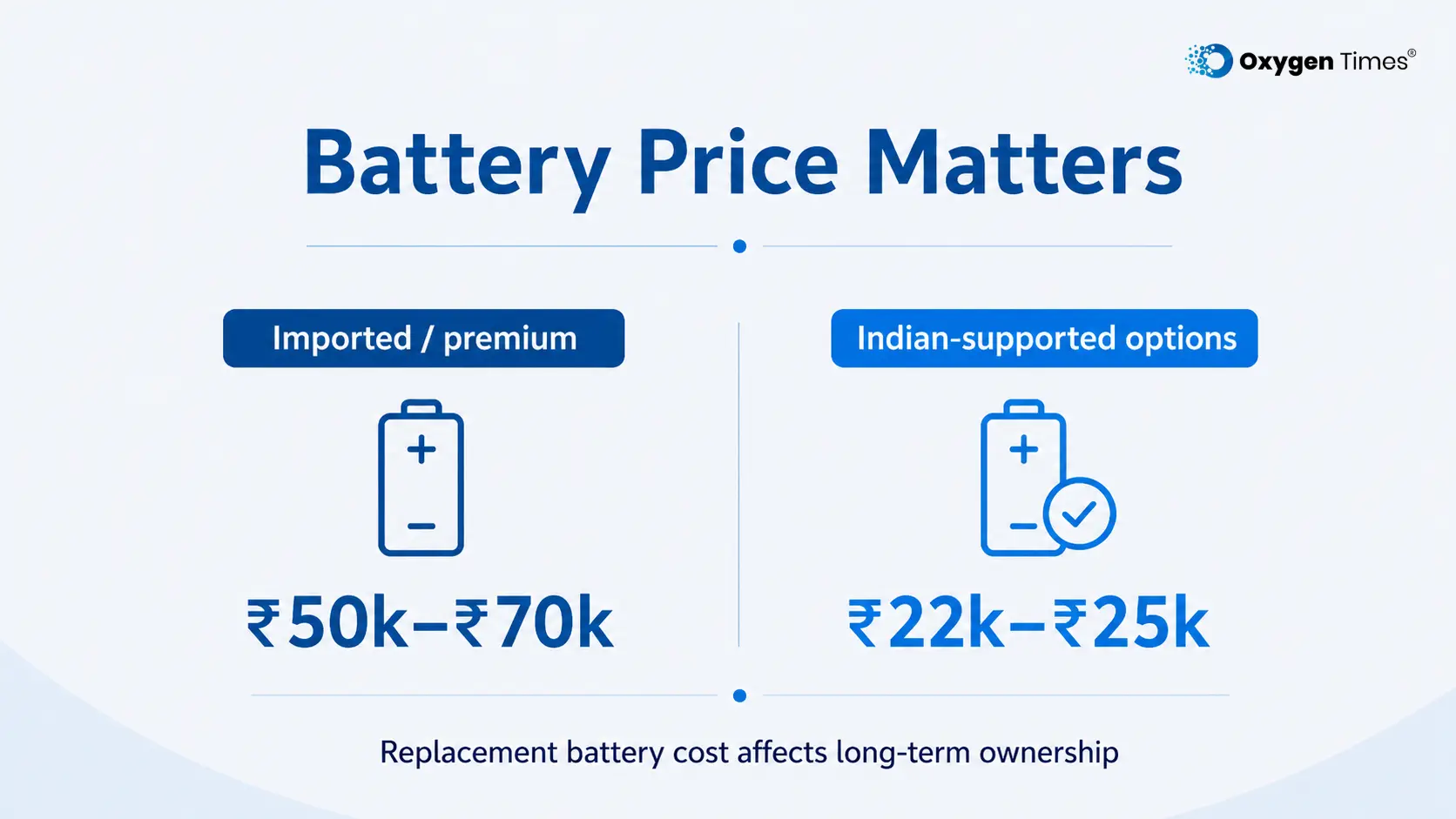
In comparison, brands such as Oxysure and Oxymed usually have battery prices around ₹22,000 to ₹25,000, making them more affordable for long-term use in India.
This matters because most regular users eventually need an extra battery or a replacement battery.
Charging time is also important
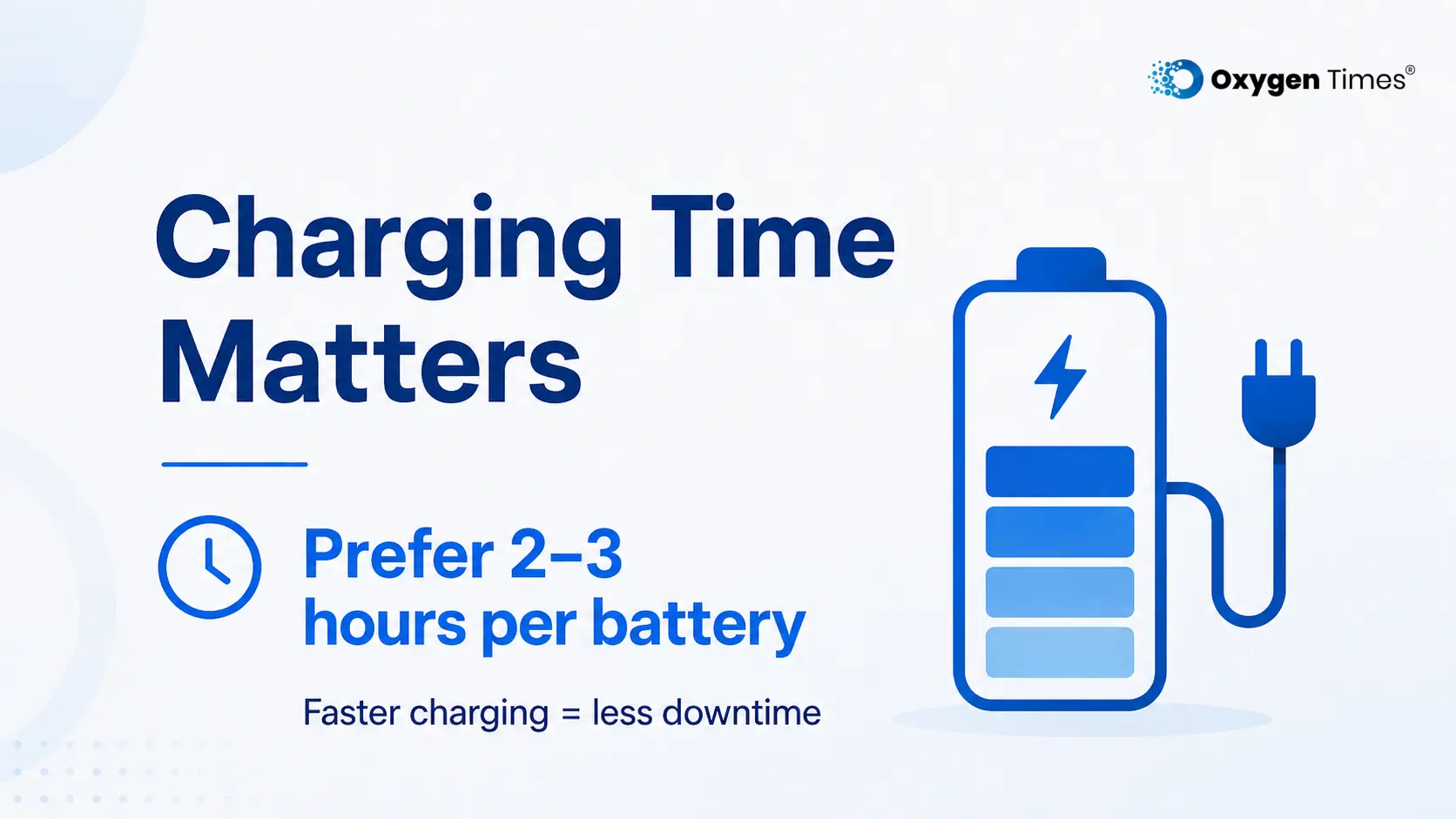
Battery backup is important, but charging time is equally important.
A battery that takes 4–5 hours to charge can become inconvenient for users who travel frequently or use the machine outdoors. For most users, a charging time of around 2–3 hours per battery is more practical.
A fast-charging battery reduces downtime and makes the device easier to use during travel, hospital visits, and daily outdoor movement.
Air travel battery planning
For air travel, battery planning becomes even more important.
Many airlines require users to carry enough fully charged batteries for 150% of the expected flight duration. For example, for a 10-hour flight, the user may need around 15 hours of battery backup based on the prescribed flow or pulse setting. Some airline and government passenger guidance also mentions carrying enough battery supply for no less than 150% of flight duration.
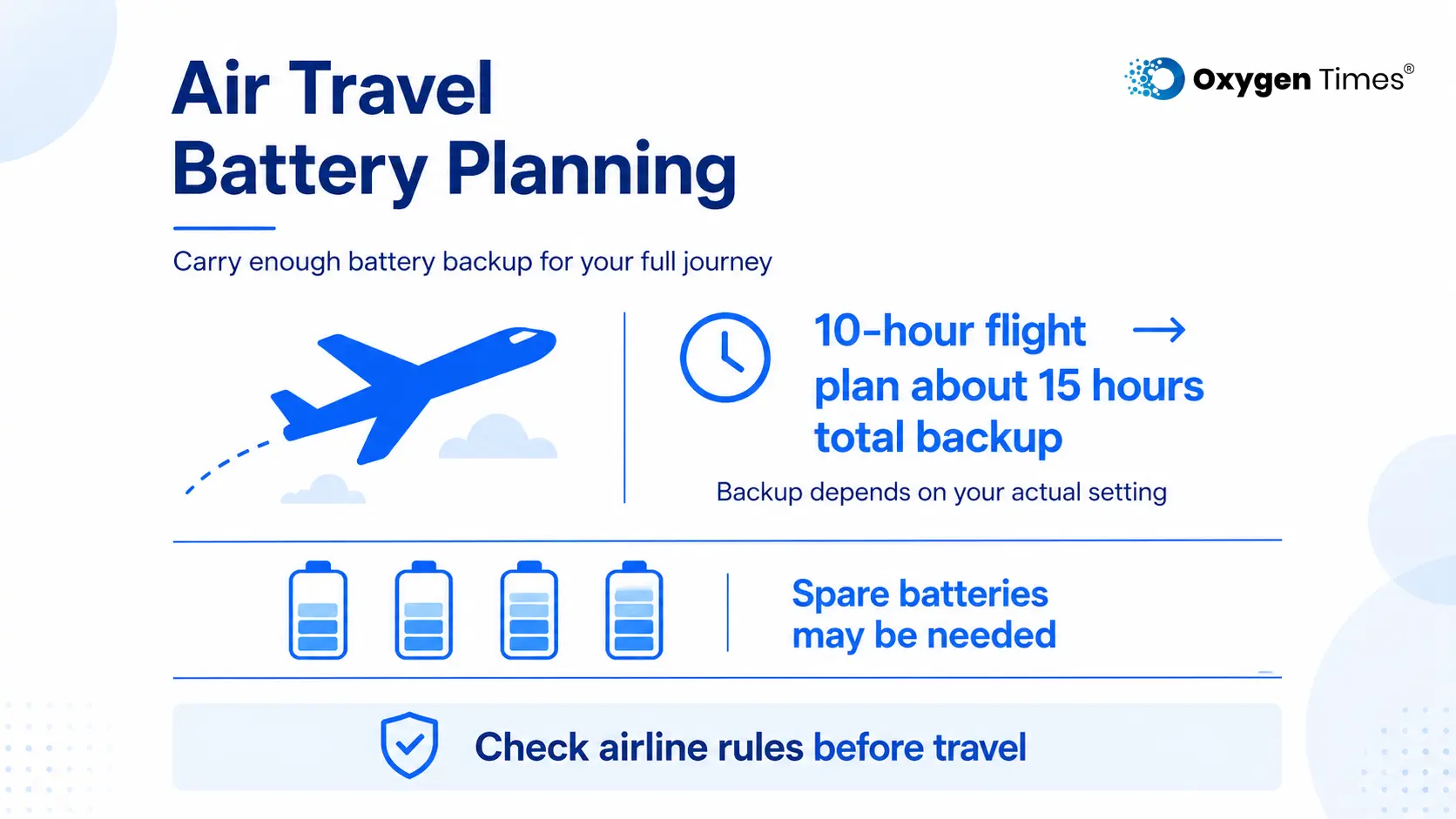
This means a patient may need 2 to 4 spare batteries depending on:
- Flight duration
- Oxygen setting
- Battery backup at that setting
- Airline policy
- Layovers and delays
So before buying a POC for travel, check the battery price, battery backup at your setting, and charging time together.
Buyer Tip:
Do not compare POCs only by maximum battery backup. Always check real backup at the patient’s required oxygen setting.
2. Weight Should Be Checked With the Battery Installed
Weight is one of the biggest comfort factors in a portable oxygen concentrator, especially for respiratory patients.
Many oxygen users already feel breathless while walking, climbing stairs, or moving outdoors. If the machine is heavy, the extra carrying load can make them feel more tired and may increase shortness of breath during movement.
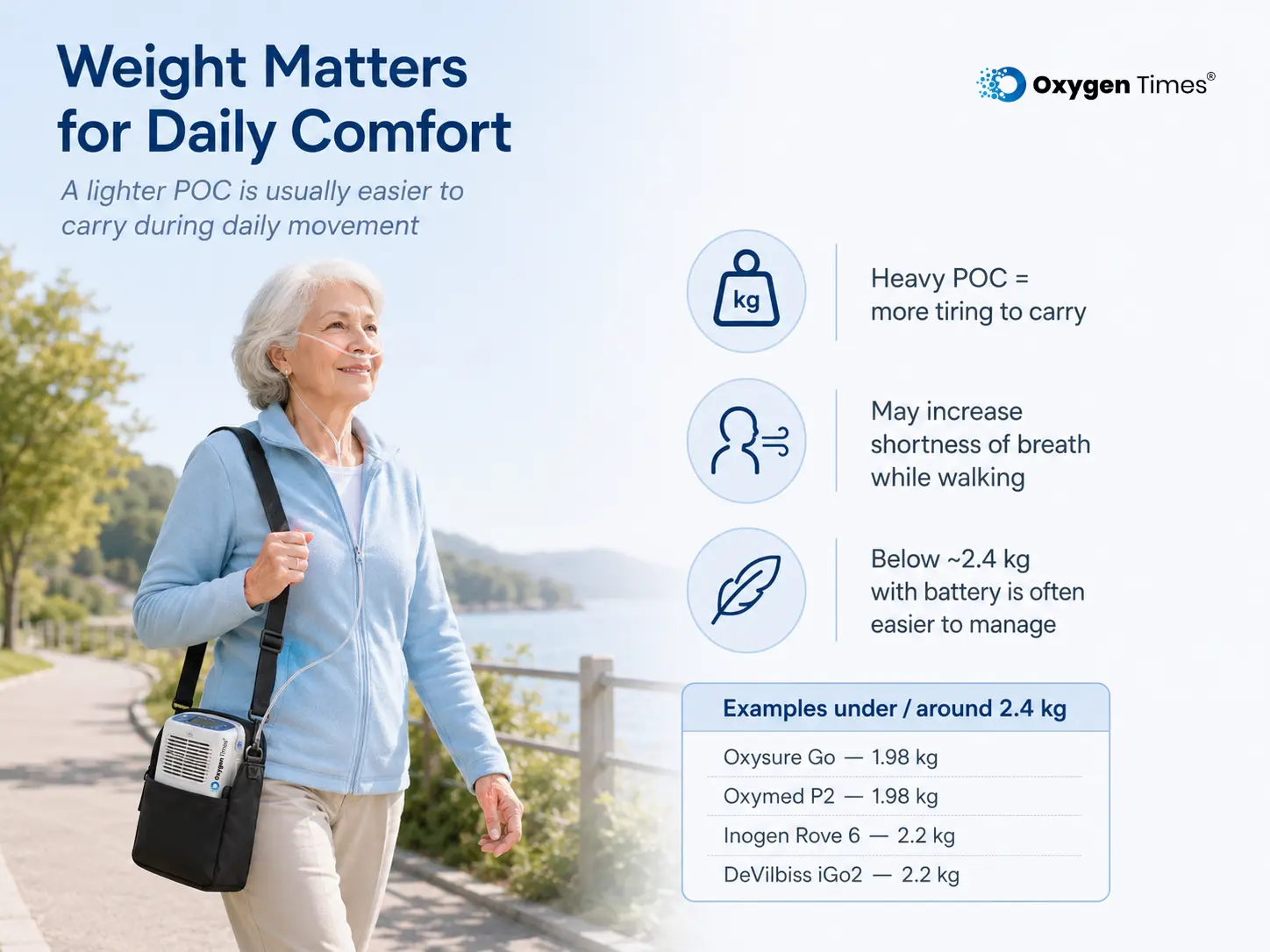
This is why a portable oxygen concentrator should not only be suitable according to the patient’s oxygen requirement, but also physically comfortable to carry.
Based on our observation at Oxygen Times, most patients prefer portable oxygen concentrators that weigh below around 2.4 kg with battery installed, especially for daily outdoor use, hospital visits, and travel. This weight range is generally easier to manage for users who experience breathlessness during movement.
Some of the major portable oxygen concentrator models under or around this preferred weight range include:
- Oxysure Go – 1.98 kg
- Oxymed P2 – 1.98 kg
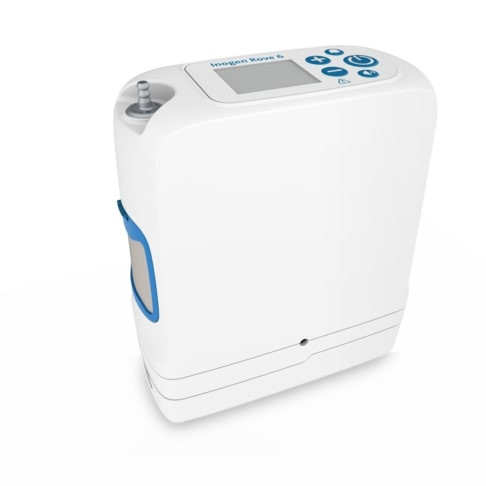
- Inogen Rove 6 – 2.2 kg
- DeVilbiss iGo2 – 2.2 kg
Machines heavier than this can still be suitable for some users, depending on their oxygen requirement and usage pattern. However, they may feel less comfortable for elderly patients or users who need to carry the device for longer periods.
Always Check Weight With Battery
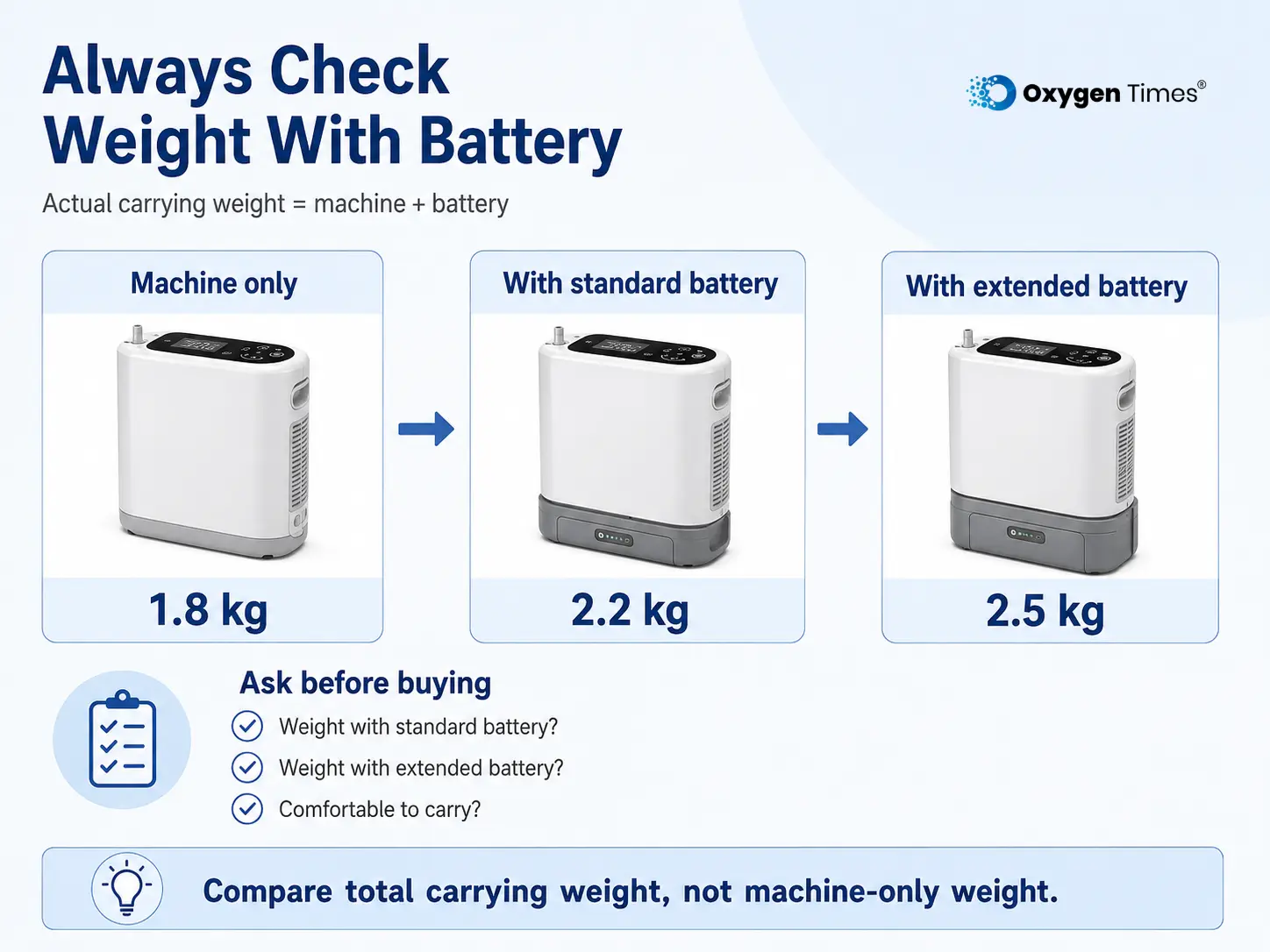
Some brands mention the machine weight without battery. This can make the device look lighter on paper.
But in real life, the patient will use the machine with the battery installed. So the actual carrying weight is the machine plus battery, not the machine body alone.
Before buying, always ask:
- What is the machine weight with standard battery?
- What is the weight with extended battery?
- Does the carry bag feel comfortable?
- Can the user carry it on the shoulder for 20–30 minutes?
- Is a trolley option available?
Buyer Tip:
For most respiratory patients, a POC under around 2.4 kg with battery is easier to manage for daily movement and travel. Always compare the weight with battery installed, not machine-only weight.
3. User-Replaceable Sieve Beds Make Long-Term Maintenance Easier
Portable oxygen concentrators with user-replaceable sieve beds are easier to maintain in the long run.
They allow the user or caregiver to replace the sieve beds without repeatedly sending the machine to a service centre, depending on the model’s design and instructions.
This is especially useful for:
- Long-term oxygen users
- Frequent travellers
- Users living outside metro cities
- Patients who want lower downtime
- Families who want more control over maintenance
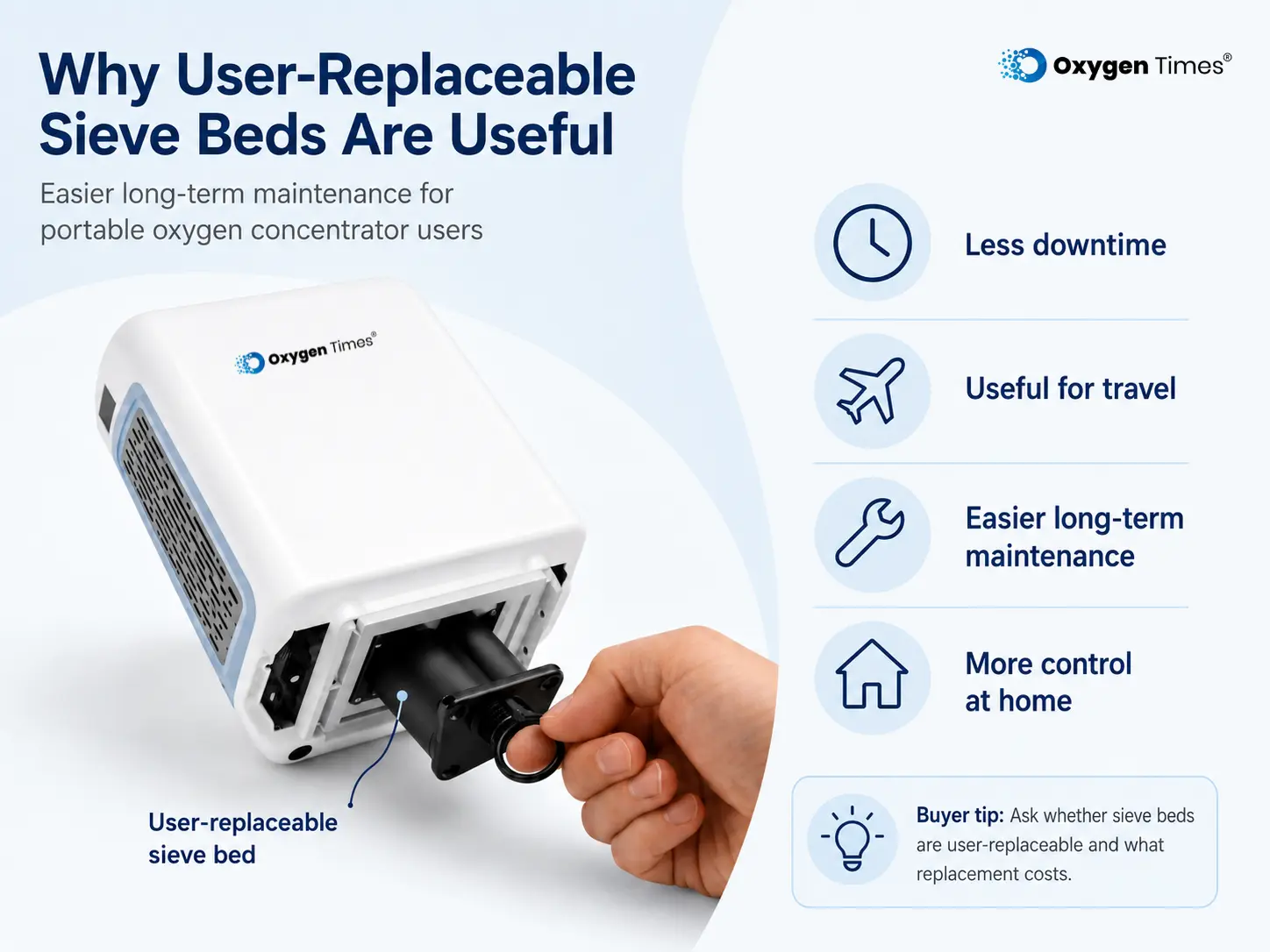
In many cases, user-replaceable sieve beds can also help reduce long-term service expenses. Since the machine does not always need to be sent to a service centre for sieve bed replacement, many users may save around ₹10,000 to ₹15,000 in service-related costs over time.
Some models, such as Inogen Rove 6 and Oxysure Go, offer user-replaceable sieve beds. Many other portable oxygen concentrators require service-centre replacement.
Before buying a POC, also ask about the price of key spare parts such as:
- Battery
- Sieve beds
- Filters
These parts directly affect the long-term ownership cost of the machine.
Buyer Tip:
If you are buying a POC for long-term use, ask whether the sieve beds are user-replaceable, how much replacement costs, and whether important spare parts like the battery, sieve beds, and filters are easily available.
4. Indian Availability and Spare Parts Support Are Important
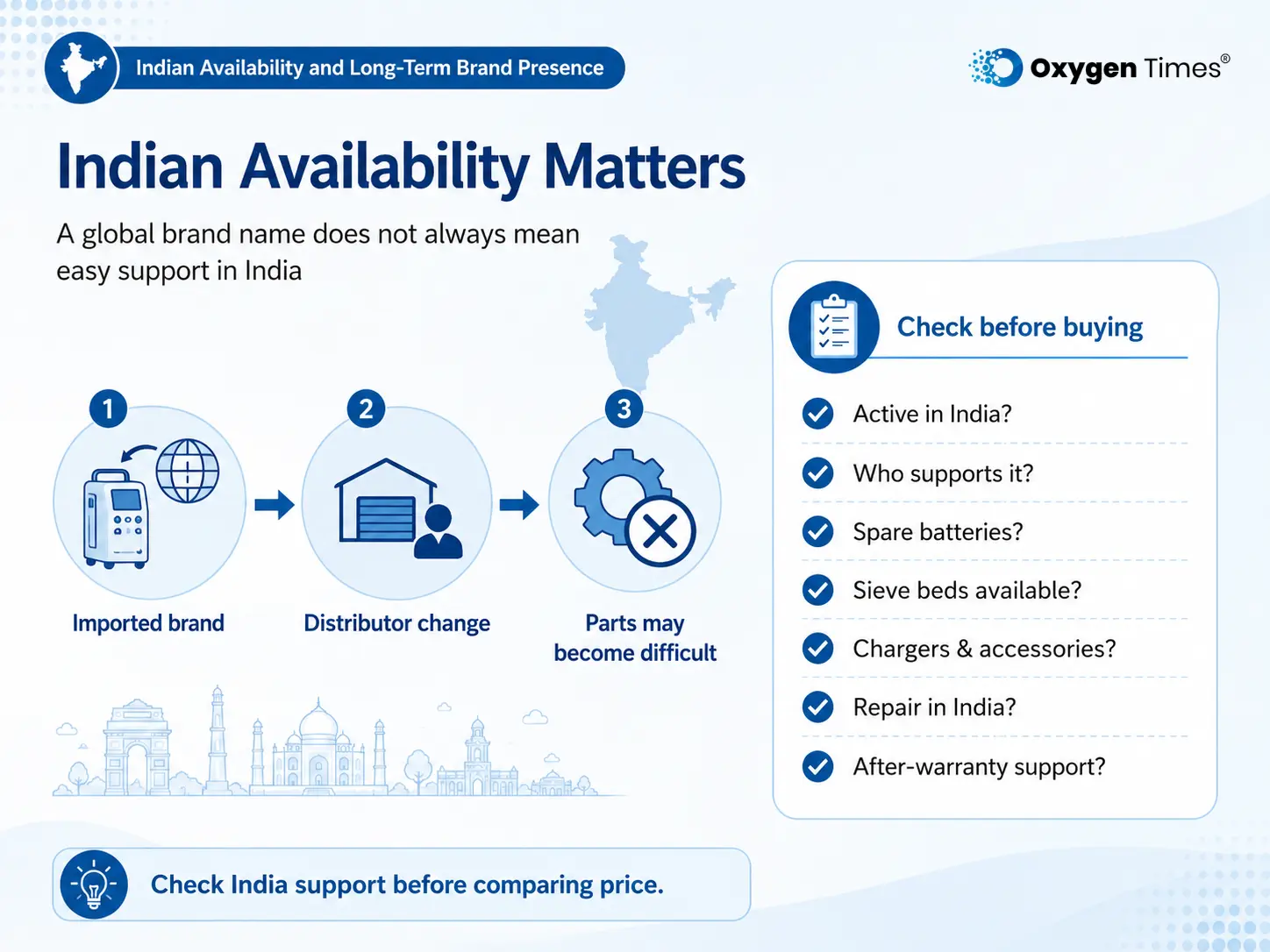
A global brand name does not always mean easy service in India.
Many international brands enter India through distributors. Sometimes, after a few years, the distributor changes or stops actively supporting the product. When this happens, users may face difficulty getting batteries, chargers, sieve beds, filters, and repair parts.
This is a common issue with imported medical devices.
A machine may be excellent technically, but if spare parts are not available in India, it becomes difficult to maintain.
Check Whether the Brand Is Actively Supported in India
For Indian buyers, brand presence in India is very important. Brands with Indian-origin operations, such as Oxysure and Oxymed, may offer better long-term convenience because their products, spare parts, and service support are more focused on Indian users.
Similarly, global healthcare brands such as Philips Respironics can also be a good option when they have an active registered presence, service structure, and spare-part support in India. The key point is not whether the brand is Indian or global, but whether the brand has reliable support in India after purchase.
Before buying a portable oxygen concentrator, ask:
- Is the brand currently active in India?
- Who imports or supports the product?
- Does the brand have Indian-origin or registered India presence?
- Are spare batteries available?
- Are sieve beds available?
- Are filters, chargers, and accessories available?
- Is repair possible in India?
- What happens after warranty?
Some older imported models have become difficult to support in India because of limited spare-part availability or distributor changes. This is why Indian availability should be checked before buying, especially for expensive imported POCs.
Buyer Tip:
Do not buy only because the brand is famous globally. Buy a model from a brand that has current service, spare parts, and warranty support in India. Indian-origin brands like Oxysure and Oxymed, and global brands with proper India presence like Philips Respironics, are generally safer to consider than imported models with unclear long-term support.
5. Know Who Handles Service: Company or Distributor
Service support is one of the most important things to check before buying a portable oxygen concentrator.
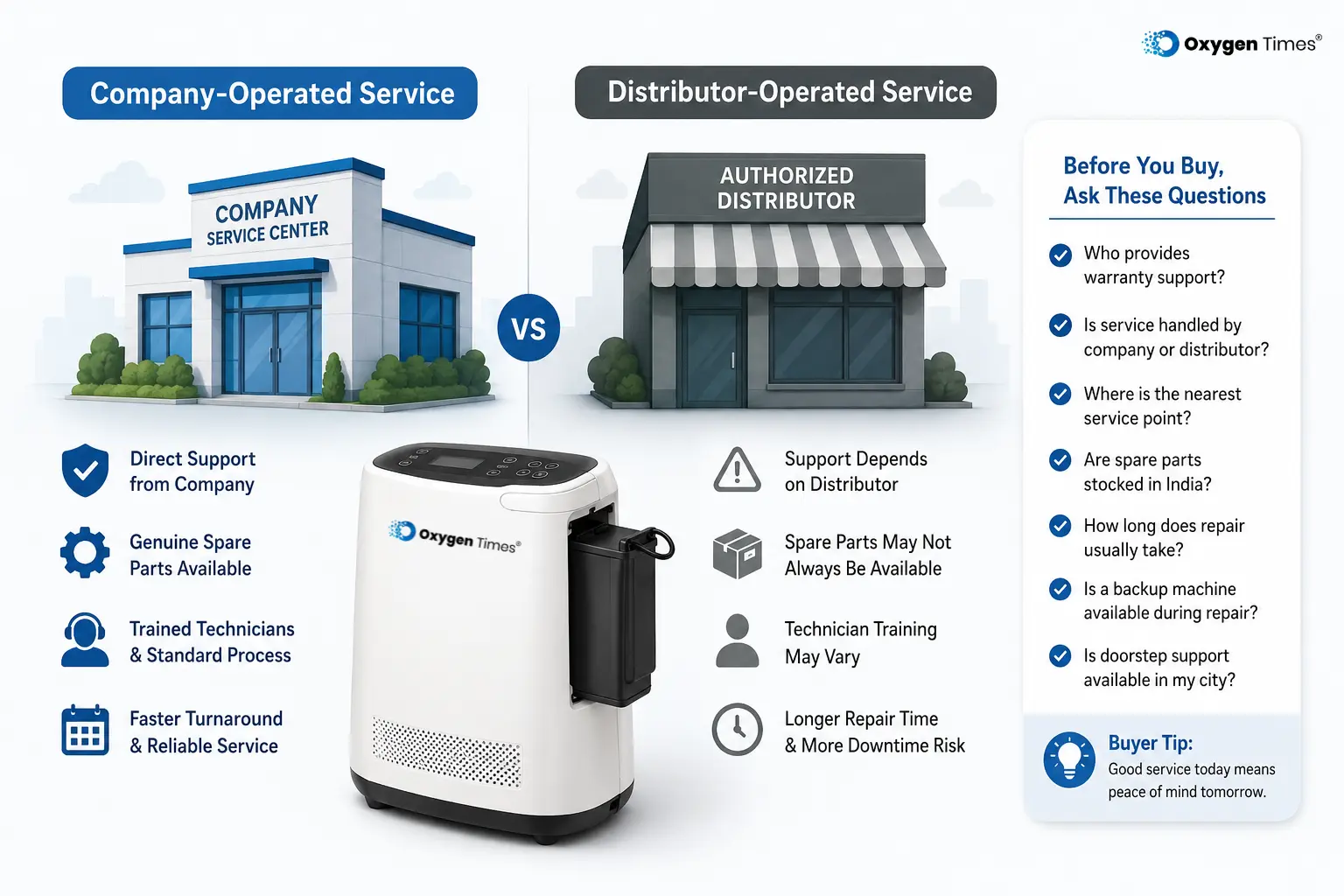
There are usually two types of service models:
- Company-operated service
- Distributor-operated service
Both can work, but the buyer should understand who is responsible for warranty, repair, spare parts, and long-term support.
Why this matters
In distributor-operated service, support depends heavily on the distributor. If the distributor changes, stops importing the product, or does not stock parts, the user may face problems later.
In company-operated or India-focused service models, support may be more stable because the brand or company is directly involved in customer service and spare-part management.
This is why many Indian buyers prefer brands with a clearer service presence in India. Brands such as Oxysure, Oxymed, and Philips Respironics have stronger India-focused availability compared to many imported brands that depend mainly on changing distributor networks.
Before buying, ask the seller clearly:
- Who provides warranty support?
- Is service handled by the company or distributor?
- Where is the nearest service point?
- Are spare parts stocked in India?
- How long does the repair usually take?
- Is a backup machine available during repair?
- Is doorstep support available in my city?
For oxygen therapy users, downtime can be stressful. So service support should be checked before comparing final prices.
Buyer Tip:
A slightly cheaper machine may become expensive later if service is slow or spare parts are unavailable.
6. Airline Approval Is Not Enough — Check Battery Watt-Hour Limits
Many buyers ask whether a portable oxygen concentrator is airline-approved. That is important, but it is not the only thing to check.
You also need to check the battery's watt-hour rating.
Some machines are airline-approved, but their extended batteries may create issues if the battery capacity is too high.
Machine approval and battery approval are different
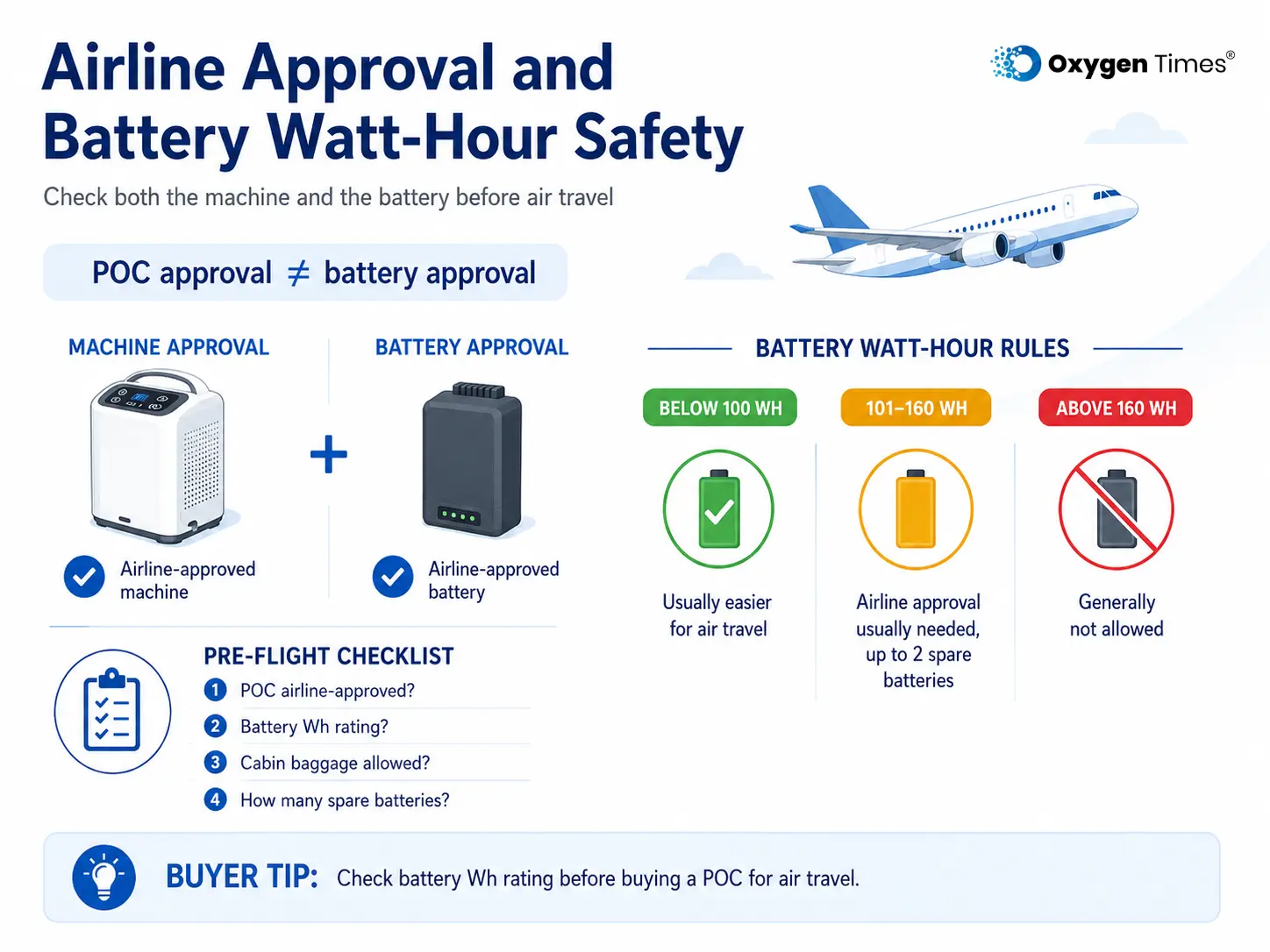
A POC may be accepted for airline use, but the battery still needs to follow airline lithium battery rules.
According to FAA battery guidance, lithium-ion rechargeable batteries are generally limited to 100 Wh per battery. Batteries between 101 Wh and 160 Wh usually need airline approval and are limited to two spare batteries. Batteries above 160 Wh are generally not allowed for passenger air travel.
This is why buyers should check both:
- Is the POC airline-approved?
- What is the watt-hour rating of the battery?
- Is the battery below 100 Wh?
- If it is 101–160 Wh, has the airline approved it?
- Is the battery allowed in cabin baggage?
- How many spare batteries can be carried?
Large Batteries Can Create Travel Problems
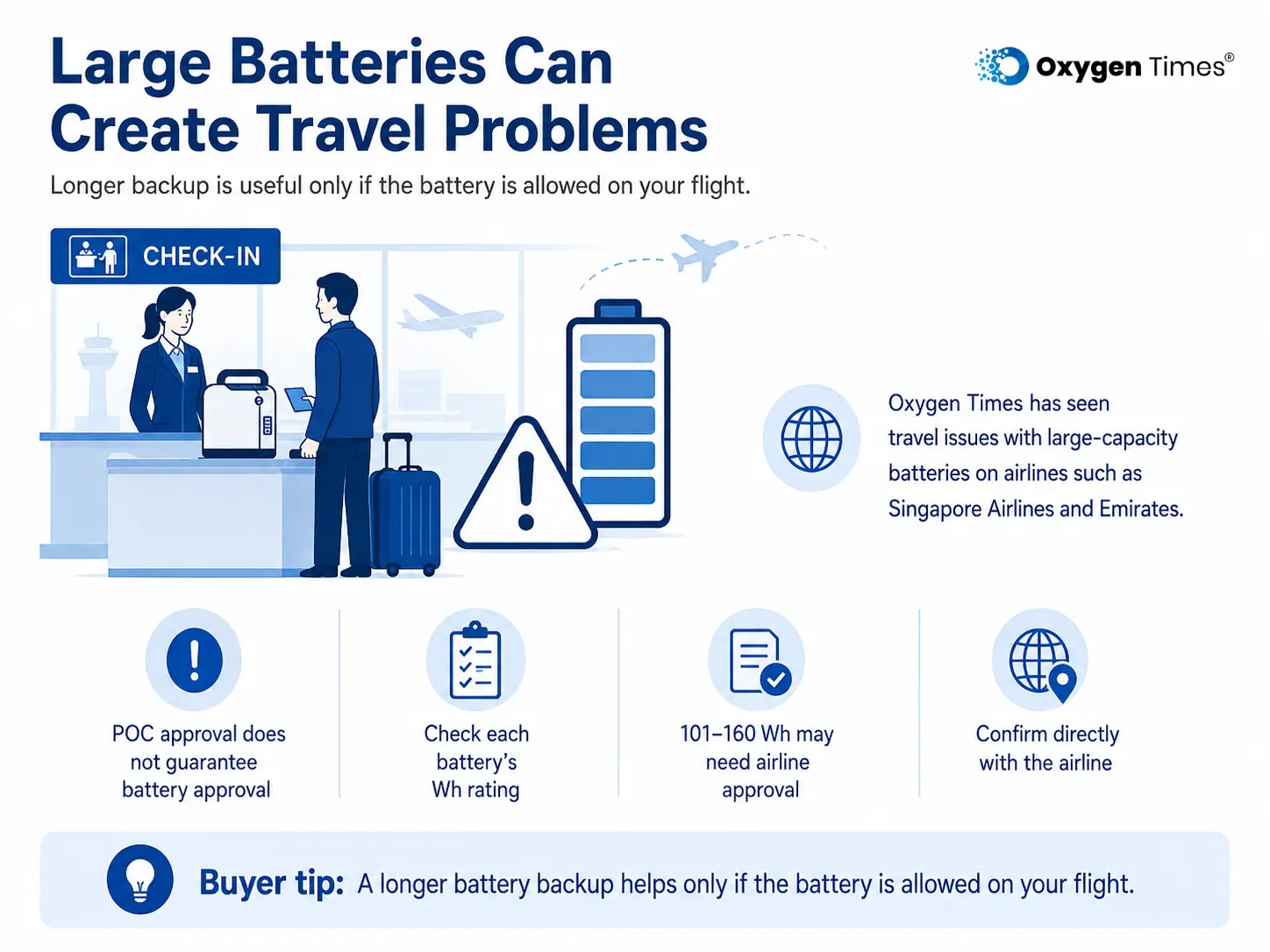
Some companies use large-capacity batteries to show longer battery backup. While this may look attractive on paper, it can create problems during air travel if the battery watt-hour rating exceeds airline limits.
This is something we have seen in real cases at Oxygen Times.
In our experience, some patients travelling with major international airlines, including Singapore Airlines and Emirates, were not allowed to carry large-capacity batteries despite having airline approval documents for the portable oxygen concentrator itself. The issue was not always the machine approval; in these cases, the concern was the battery capacity.
This usually happens with large extended batteries, especially high-capacity batteries such as 16-cell batteries, where the watt-hour rating may be above the permitted airline limit. Many users assume that if the POC is airline-approved, all its batteries will also be accepted. That is not always true.
Before buying a portable oxygen concentrator for flight travel, always check:
- Whether the POC model is airline-approved
- The watt-hour rating of each battery
- Whether the battery is below 100 Wh
- Whether batteries between 101–160 Wh need prior airline approval
- Whether the airline allows the number of spare batteries you plan to carry
- Whether large-capacity or 16-cell batteries are accepted on that specific route
For international travel, do not rely only on the seller’s statement or approval certificate. Confirm directly with the airline before the journey.
Buyer Tip:
A longer battery backup is useful only if the battery is actually allowed on your flight. Always check the battery watt-hour rating before buying a POC for air travel.
Quick Checklist Before Buying a Portable Oxygen Concentrator
| What to Check | Why It Matters |
|---|---|
| Battery price | Replacement batteries can become a major long-term cost |
| Backup at your setting | “Up to” backup is usually at the lowest pulse setting |
| Charging time | Faster charging reduces downtime during daily use and travel |
| Weight with battery | Real carrying comfort depends on the full machine weight |
| User-replaceable sieve beds | Makes long-term maintenance easier |
| Indian availability | Spare parts and repair support matter after purchase |
| Service model | Company-operated and distributor-operated support can differ |
| Airline battery watt-hour | Battery approval can affect air travel |
Prescription Comes First
A portable oxygen concentrator should always be selected according to the patient’s oxygen requirement.
Do not choose a POC only because it is lightweight, affordable, or popular. The right machine should maintain the user’s oxygen saturation during rest, walking, and travel.
Before buying, consult the treating doctor and confirm:
- Required oxygen flow or pulse setting
- Whether pulse dose is suitable
- Whether continuous flow is needed
- Whether the machine can be used during sleep
- Target SpO₂ level
- Oxygen requirement during walking or exertion
A machine that works for one patient may not be suitable for another.
FAQs
What is the most important thing to check before buying a portable oxygen concentrator?
The most important thing is whether the machine matches the patient’s oxygen requirement. After that, check real battery backup at the required setting, battery price, machine weight with battery, service support, sieve bed replacement, and airline battery rules.
Is “up to 10 hours” battery backup reliable?
“Up to 10 hours” usually means the maximum backup at the lowest pulse setting. As the pulse setting increases, battery backup reduces. Always ask for backup at the patient’s actual prescribed setting.
How much does a portable oxygen concentrator battery cost?
Battery price depends on the brand and model. Many premium American POC batteries can cost around ₹50,000 to ₹70,000 in India, while brands such as Oxysure and Oxymed usually offer batteries around ₹22,000 to ₹25,000. Prices may vary by model and availability.
What is the ideal weight for a portable oxygen concentrator?
For regular outdoor use, many respiratory patients prefer machines below around 2.4 kg. However, the right choice depends on oxygen requirement, battery backup, carrying comfort, and doctor’s advice. Always check the weight with battery installed.
Are user-replaceable sieve beds important?
Yes, user-replaceable sieve beds can make long-term maintenance easier. They reduce dependency on service-centre visits and can be useful for frequent travellers or users living outside major cities.
Which portable oxygen concentrators have user-replaceable sieve beds?
Some models such as Inogen Rove 6 and Oxysure Go offer user-replaceable sieve beds. Many other portable oxygen concentrators require service-centre replacement.
Should I buy a global brand or an Indian-supported brand?
A global brand can be good, but only if it has active support, spare parts, and service availability in India. Before buying, check who handles warranty, where service is available, and whether batteries and sieve beds are easily available.
What is the difference between company-operated and distributor-operated service?
In company-operated service, the brand or company is directly involved in support. In distributor-operated service, warranty and spare parts depend on the distributor. Distributor service can work well, but buyers should confirm repair timelines and spare-part availability before purchase.
Is every airline-approved POC battery allowed on flights?
No. A machine may be airline-approved, but the battery watt-hour rating still matters. Batteries under 100 Wh are generally easier to carry, while 101–160 Wh batteries usually need airline approval and are limited. Batteries above 160 Wh are generally not allowed for passenger air travel.
How much battery backup do I need for a flight?
Many airlines require enough battery backup for 150% of the expected flight duration. For example, for a 10-hour flight, you may need around 15 hours of battery backup at your prescribed setting. Always confirm with the airline before travel.
Final Verdict
Before buying a portable oxygen concentrator in 2026, do not compare only the purchase price or advertised battery backup.
A good POC should be selected after checking:
- Battery price
- Real backup at the prescribed setting
- Charging time
- Weight with battery
- User-replaceable sieve beds
- Indian service and spare parts availability
- Company or distributor support
- Airline approval and battery watt-hour rating
For Indian buyers, long-term ownership cost and service support are especially important. A machine that looks cheaper today may become expensive later if batteries, sieve beds, or service are difficult to arrange.
The right portable oxygen concentrator should match the patient’s oxygen prescription, travel needs, mobility comfort, and budget.
Need help choosing the best Portable Oxygen Concentrator?
Our oxygen therapy experts are here to help you find the perfect match for your needs.
Need help choosing the best Portable Oxygen Concentrator?
Our oxygen therapy experts are here to help you find the perfect match for your needs.
